
Education as Industry Stewardship

When people talk about jewelry industry education, they often talk about it as if it were a category. Bench skills over here. Retail management over there. Gemology somewhere else entirely. Workforce issues discussed in one room, business strategy in another, if they are discussed at all. That fragmentation is not accidental. It mirrors how the industry itself has evolved, with each segment solving its own problems in isolation.
The problem is that jewelry businesses do not actually operate that way.
A retail store struggling to hire bench talent is not experiencing a bench problem. It is experiencing an ecosystem problem. A manufacturer frustrated by inconsistent retail execution is not dealing with a sales training issue alone. They are dealing with a breakdown in shared understanding across the supply chain, complicated by broader breakdown in retail workforce across industries. Education sits right at the center of all those variables.
That is why the Atlanta Jewelry Show has deliberately chosen to treat education not as a side attraction, but as an act of stewardship.
Stewardship is a useful word here because it implies responsibility without ownership. The show does not claim to be the sole source of education in the industry, and it should not be. What it can do, however, is provide a platform where education becomes visible, connected, and grounded in the realities of how jewelry businesses actually function.
That role is made possible by the structure of the show itself. Because the Atlanta Jewelry Show is produced by the Southern Jewelry Travelers Association, a 501(c)(6) nonprofit trade association, it is not required to justify education purely in terms of short-term return. It can invest in learning that strengthens the industry even when the payoff is indirect or long-term. And that matters, because the most important educational outcomes in this industry rarely show up in an obvious way on a balance sheet.
The vision for education at the Atlanta Jewelry Show starts with a simple premise: Jewelry careers are not linear, and education should not be siloed. People move between roles. Bench jewelers become managers. Retail associates become store owners. Designers become manufacturers. Family members enter the business with alternate industry experience or perhaps no formal background at all. The jewelry industry has always learned in pieces, through apprenticeships, experience, and specialized paths, which makes it especially valuable to have places where those pieces can come together and form a more coherent picture for the people running businesses day to day.
That is where the show’s three education tracks, RetailFusion, BenchFusion, and FutureFusion, begin to make sense as a connected system rather than separate programs.
RetailFusion exists because running a jewelry business today requires more than instinct and experience. Owners and managers are navigating pricing pressure, staffing challenges, technology decisions, shifting customer expectations, and regulatory complexity, often simultaneously. RetailFusion is designed to help participants understand how those forces interact, not by offering abstract theory, but through practical education in the kinds of decisions they are already making every day.
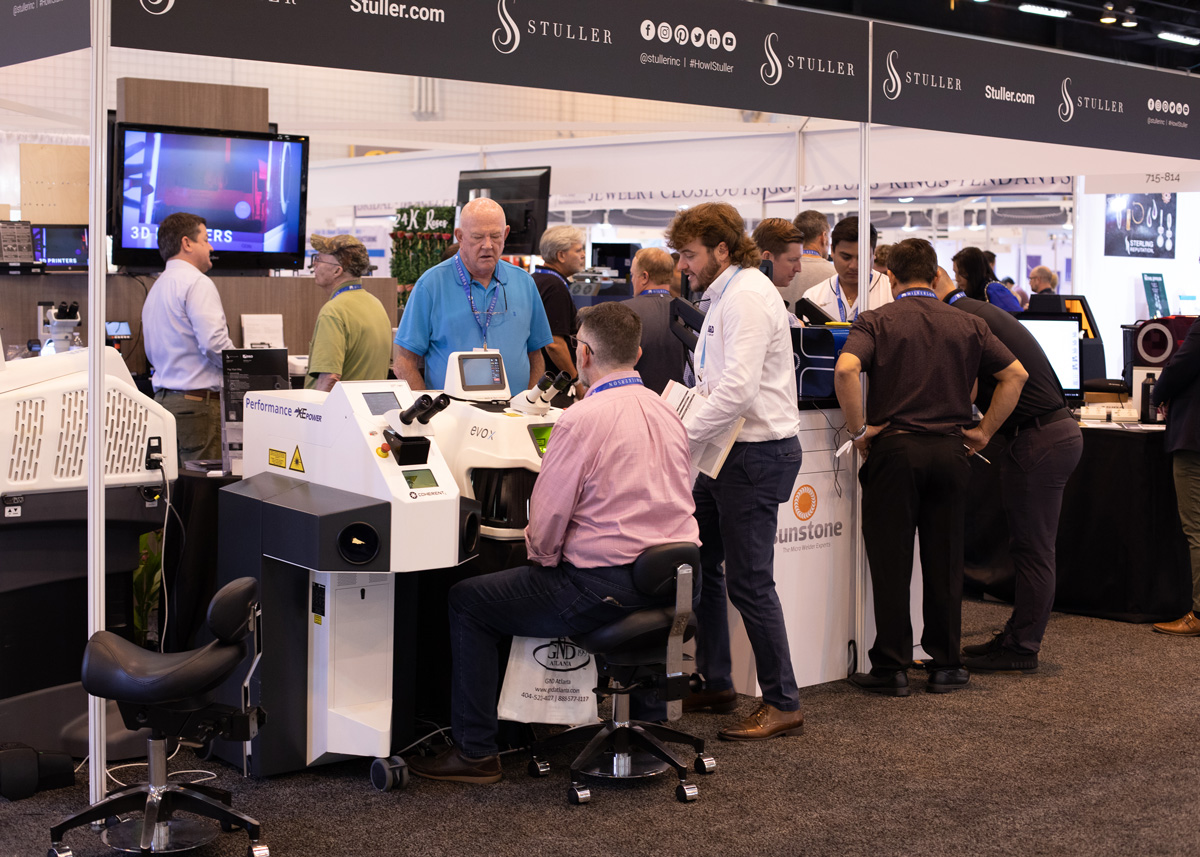
BenchFusion addresses a different but equally critical reality. Skilled bench jewelers are in short supply, and the time required to develop mastery is substantial. BenchFusion is not simply about technique. It is about preserving institutional knowledge, honoring craftsmanship, and acknowledging that the bench is not a back-room function, but a strategic asset for retail and manufacturing businesses alike. By placing bench education directly on the show floor, the program reinforces that connection in a very literal way.
FutureFusion extends the timeline even further. One of the industry’s great vulnerabilities is that too few young people can imagine a future for themselves in jewelry. Not because the work lacks meaning, but because exposure comes too late, if it comes at all. FutureFusion is built on the understanding that curiosity precedes commitment. By introducing children and teenagers to real tools, real materials, and real processes, the program plants ideas that may not take shape for years, but often take root far earlier than we expect.
What matters most is not that these programs exist individually. It is that they exist together, in the same place, within the same ecosystem. That proximity creates context. Retailers can see how bench education connects to staffing and customer experience. Bench professionals gain support for growth and recognition. Educators gain insight into what businesses actually need. Students and young participants encounter an industry that excites them, and which feels accessible rather than opaque.
This is the Atlanta Jewelry Show's intentional response to a long-standing problem in the jewelry industry: the lack of a shared vision for cultivating future talent.
Jewelry has always been taught through doing, through mentorship, and through small centers of excellence where knowledge runs deep. What we are beginning to see now is the opportunity to connect those strengths, to give the industry a more shared vocabulary that allows insight to travel more easily between roles, generations, and business models.
By bringing education into the heart of the show, rather than keeping it on the margins, the Atlanta Jewelry Show is attempting to do something subtle but important. It is making learning a collective experience rather than a private one. It is creating space for the industry to see itself more clearly, across roles and generations, and to have conversations that would not happen otherwise.
That is what stewardship looks like in practice. Not controlling education, but convening it. Not prescribing answers, but creating conditions where better questions can be asked. And ultimately, helping an industry that depends on skill, trust, and long-term relationships invest in the people who will carry it forward.